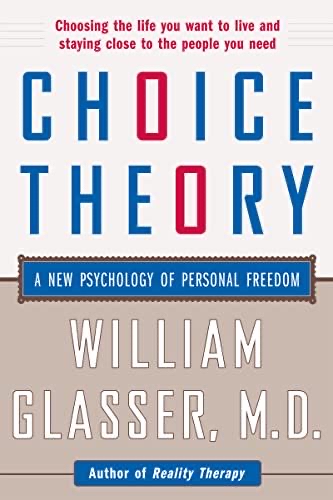

Sarah's notes on Choice Theory
Choice Theory by William Glasser
28 notes
first 25, in reading order"The best thing parents can do for their children is love each other.“
The seeds of almost all our unhappiness are planted early in our lives when we begin to encounter people who have discovered not only what is right for them--but also, unfortunately, what is right for us.
We end up believing that other people can actually make us feel the way we feel or do the things we do. This belief takes away the personal freedom we all need and want.
Many times in life, when we are miserable it is because we continue to blame others for our misery or try to control others when it is against our best interest to do so.
To be happy, I believe we need to be close to other happy people.
Look for someone who has good friends whom he or she treats well and whom you enjoy being with, too. Someone who does not have good friends does not know how to love.
People who fall in love are learning a lot about each other, and they find themselves laughing almost continually.
These are our choices when we want to stop choosing a painful behavior like depressing: (1) change what we want, (2) change what we are doing, or (3) change both.
The best choice is not necessarily a good choice but that it seems good at the time you choose it.
You are choosing what you are doing, but you are capable of choosing something better. If it is a choice, it follows that you are responsible for making it.
Although we are not aware of it, depressing is also one of the most powerful ways that human beings have discovered to restrain angering, and all of us use it a lot. But, as I will soon explain, in its own way, depressing is a very strong controlling behavior.
If one partner has a high need for freedom and the other has a low need, there is no problem until the partner with the low need tries to limit the other's freedom.
the best marriages share an average need for survival, a high need for love and belonging, low needs for power and freedom, and a high need for fun.
To assess the strength of your need for power, ask yourself if you always want to have your own way, to have the last word, to own people,…
If you and your partner or prospective partner trust each other enough to share your quality worlds, there is a good chance you love each…
A small compromise sends the message, I care more about our relationship than I do about what I want personally. This is a powerful message.
3 more notes from Choice Theory
Sarah kept 28 notes on this book, each one pinned to the page it came from.
Read the rest in the app



Keep what you read, not just what you finished.
Booksense times your sessions and pins every note to the page it came from, so a paragraph from page 174 is still yours a year later. Free on iOS.