
Farnaz p. -2
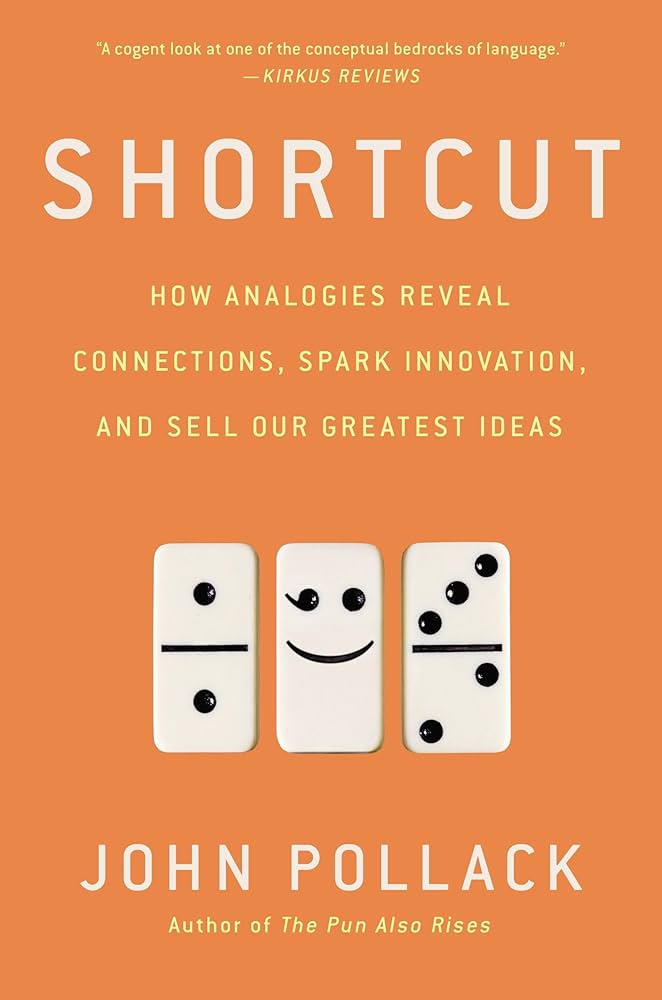
Shortcut
How Analogies Reveal Connections, Spark Innovation, And Sell Our Greatest Ideas
by John Pollack
Readers 4
Notes taken 84
How long will this one take you? Booksense times every session, so the answer comes from your own reading rather than a word count. Get Booksense free
About this book
"A presidential speechwriter for Bill Clinton explores the hidden power of analogy to fuel thought, connect ideas, spark innovation, and shape outcomes From the meatpacking plants that inspired Henry Ford's first moving assembly line to the "domino theory" that led America into Vietnam to the "bicycle for the mind" that Steve Jobs envisioned as the Macintosh computer, analogies have played a dynamic role in shaping the world around us-and still do today. Analogies are far more complex than their SAT stereotype and lie at the very core of human cognition and creativity. Once we become aware of this, we start seeing them everywhere-in ads, apps, political debates, legal arguments, logos, and euphemisms, to name just a few. At their very best, analogies inspire new ways of thinking, enable invention, and motivate people to action. Unfortunately, not every analogy that rings true is true. That's why, at their worst, analogies can deceive, manipulate, or mislead us into disaster. The challenge? Spotting the difference before it's too late. Rich with engaging stories, surprising examples, and a practical method to evaluate the truth or effectiveness of any analogy, Shortcut will improve critical thinking, enhance creativity, and offer readers a fresh approach to resolving some of today's most intractable challenges."--
Notes by reader
2 collectionsWhat readers marked
84 notes from readers tracking it Farnaz p. -3
while they often operate unnoticed, analogies aren't accidents, they're arguments—arguments that, like icebergs, conceal most of their mass and power beneath the surface. In many arguments, whoever has the best analogy wins.
Daniel p. 182
Daniel p. 182
Daniel p. 181
We live in a complex world, and the more complex something is, the more analogies could reasonably apply and surprise us with useful in-sights.
Daniel p. 177
The best analogies are all transformative: They help us see novel connections and relationships—insights that can unlock unrealized potential.
Daniel p. 177
"Growth comes through analogy," said Einstein, “... seeing how things connect, rather than only seeing how they might be different."
Daniel p. 177
The more diverse and rich sources of knowledge from which we can draw ideas and inspiration, the better. But how we categorize that knowledge-and how well we resist categorization determines how freely our imagination can retrieve and apply that knowledge.
Daniel p. 177
Daniel p. 176
Each of the views we encounter are "true" in their own way but do not offer us the only truth or the whole truth. What we perceive depends on how narrowly or broadly we focus our attention.
Daniel p. 175
Every note on this page was taken in Booksense.
Time your reading sessions, keep highlights on the page they belong to, and watch a streak build. Free on iOS.