
Daniel p. 247
Chapter 11 Summary: • In general, when we quit, we fear two things: that we've failed and that we've wasted our time, effort, or money. • Waste is a forward-looking problem, not a backward-looking one.
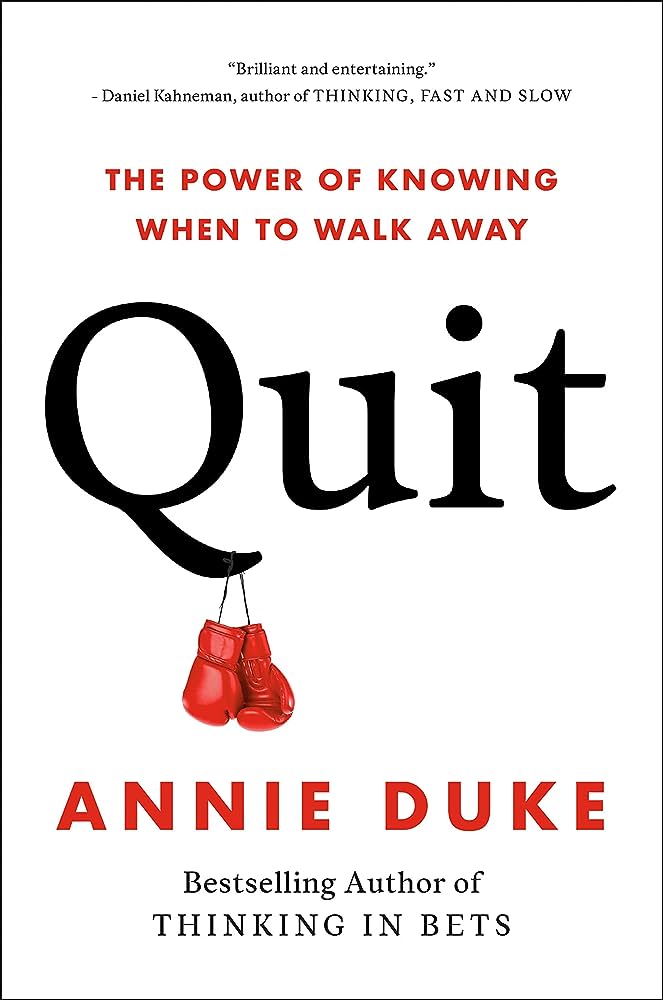
Business leaders, with millions of dollars down the drain, struggle to abandon a new app or product that just isn’t working. Governments, caught in a hopeless conflict, believe that the next tactic will finally be the one that wins the war. And in our own lives, we persist in relationships or careers that no longer serve us. Why? According to Annie Duke, in the face of tough decisions, we’re terrible quitters. And that is significantly holding us back. In Quit, Duke teaches you how to get good at quitting. Drawing on stories from elite athletes like Mount Everest climbers, founders of leading companies like Stewart Butterfield, the CEO of Slack, and top entertainers like Dave Chappelle, Duke explains why quitting is integral to success, as well as strategies for determining when to hold em, and when to fold em, that will save you time, energy, and money. You’ll learn: - How the paradox of quitting influences decision making: If you quit on time, you will feel you quit early - What forces work against good quitting behavior, such as escalation commitment, desire for certainty, and status quo bias - How to think in expected value in order to make better decisions, as well as other best practices, such as increasing flexibility in goal-setting, establishing “quitting contracts,” anticipating optionality, and conducting premortems and backcasts Whether you’re facing a make-or-break business decision or life-altering personal choice, mastering the skill of quitting will help you make the best next move.
Chapter 11 Summary: • In general, when we quit, we fear two things: that we've failed and that we've wasted our time, effort, or money. • Waste is a forward-looking problem, not a backward-looking one.
Ultimately, where you're going—where we're all going— is along whatever route will have the greatest expected value throughout our lives. That path is going to involve a lot of quitting. Contrary to popular belief, winners quit a lot. That's how they win.
We need to start thinking about waste as a forward-looking prob-lem, not a backward-looking one. That means realizing that spending another minute or another dollar or another bit of effort on something that is no longer worthwhile is the real waste.
The unlesses we attach to the goals we set allow us to follow through on the trope "process over outcome." The goal itself is outcome oriented, but the unlesses focus on process.
We need to find a way to flip the script and stop measuring ourselves solely by how far we are from the finish line. We need to start giving ourselves more credit for how far we are from where we started.
Time your reading sessions, keep highlights on the page they belong to, and watch a streak build. Free on iOS.