We take the ideas we've inherited or that we've stumbled across, and we jigger them together into some new shape.
Daniel
Daniel's notes on Where Good Ideas Come From
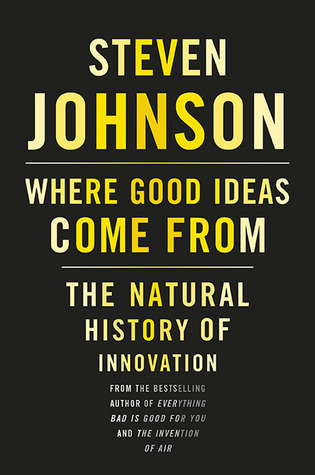
Where Good Ideas Come From by Steven Johnson
Their reading time 1h 36m
Notes 75
Sittings 2
Daniel kept every one of these while reading. Scan the paragraph, it lands on the page it came from, and comes back for review later. Take your first note
75 notes
first 25, in reading orderChance favors the connected mind.
Innovation prospers when ideas can serendipitously connect and recombine in new ways.
The adjacent possible is a kind of shadow future, hovering on the edges of the present state of things.
Being right keeps you in place. Being wrong forces you to explore.
The history of being spectacularly right has a shadow history lurking behind it: a much longer history of being spectacularly wrong, again and again.
Liquid networks speed up the global idea exchange, increasing the likelihood that the right ideas will find the right people at the right time.
The idea of the lone genius whose brilliance is the sole source of innovation is a myth.
Cities are environments that are ripe for exaptation – borrowing ideas from one context and deploying them in another.
Innovations emerge over time out of the interplay between incremental tinkering and sudden leaps.
The history of cultural progress is, almost without exception, a story of one door leading to another door, exploring the palace one room at a time.
New ideas and new inventions are combinatorial.
In the history of culture, a lot of the most important breakthroughs came from people who crossed fields.
The trick to having good ideas is not to sit around in glorious isolation and try to think big thoughts.
Chance is a potent force in the world of innovation, but it is not the only force at work.
Daniel p. 10
Daniel p. 13
The 10/10 rule: a decade to build the new platform, and a decade for it to find a mass audience. It took ten years for color TV to go from the fringes to the mainstream; two generations later, it took HDTV just as long to achieve mass success.
Daniel p. 22
If there is a single maxim that runs through this book's arguments, it is that we are often better served by connecting ideas than we are by protecting them.
Daniel p. 22
Daniel p. 29
Evolution advances by taking available resources and cobbling them together to create new uses.
Daniel p. 31
What the adjacent possible tells us is that at any moment the world is capable of extraordinary change, but only certain changes can happen.
Daniel p. 33
The history of life and human culture, then, can be told as the story of a gradual but relentless probing of the adjacent possible, each new innovation opening up new paths to explore.
Daniel p. 33
The environments of big cities allow far more commercial exploration of the adjacent possible than towns or villages, allowing tradesmen and entrepreneurs to specialize in fields that would be unsustainable in smaller population centers.
Daniel p. 35
Daniel p. 36
Technological (and scientific) advances rarely break out of the adjacent possible; the history of cultural progress is, almost without exception, a story of one door leading to another door, exploring the palace one room at a time.
Daniel p. 36
Human minds are not bound by the finite laws of molecule formation, and so every now and then an idea does occur to someone that teleports…
Daniel p. 39
The story of YouTube. Had Hurley, Chen, and Karim tried to execute the exact same idea for YouTube ten years earlier, in 1995, it would…
Daniel p. 41
The trick is to figure out ways to explore the edges of possibility that surround you. This can be as simple as changing the physical…
50 more notes from Where Good Ideas Come From
Daniel kept 75 notes on this book, each one pinned to the page it came from.
Read the rest in the app


Keep what you read, not just what you finished.
Booksense times your sessions and pins every note to the page it came from, so a paragraph from page 174 is still yours a year later. Free on iOS.