Daniel p. 3
Grant me the serenity to accept the things I cannot change, the courage to change the things I can, and the wisdom to know the difference.
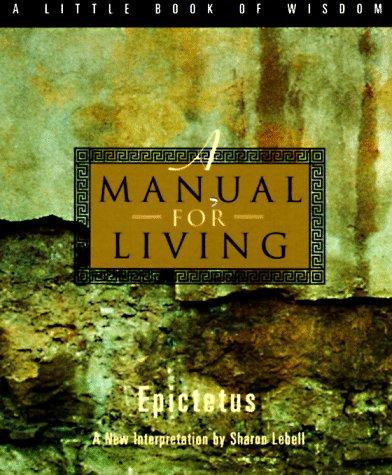
A Manual For Living by Epictetus
Grant me the serenity to accept the things I cannot change, the courage to change the things I can, and the wisdom to know the difference.
Epictetus' notion of the good life is not a matter of following a laundry list of precepts, but of bringing our actions and desires into harmony with nature.
Epictetuss prescription for the good life centered on three main themes: mastering your desires, performing your duties, and learning to think clearly about yourself and your relations within the larger community of humanity.
His demeanor was that of a light-hearted, humble teacher urging his students to take the business of living wisely very seriously.
Among his most distinguished students was the young Marcus Aurelius Antoninus, who eventually decame ruler of the Roman Empire.
Trying to control or to change what we can't only results in torment.
Desire Demands Its Own Attainment Our desires and aversions are mercurial rulers. They demand to be pleased. Desire commands us to run off and get what we want. Aversion insists that we must avoid the things that repel us.
Do your best to rein in your desire. For if you desire something that isn't within your own control, disappointment will surely follow; meanwhile, you will be neglecting the very things that are within your control that are worthy of desire.
See Things for What They Really Are Circumstances do not rise to meet our expectations. Events happen as they do. People behave as they are. Embrace what you actually get.
when you embrace your child, your husband, your wife, you are embracing a mortal. Thus, if one of them should die, you could bear it with tranquility.
When something happens, the only thing in your power is your attitude toward it; you can either accept it or resent it.
What really frightens and dismays us is not external events themselves, but the way in which we think about them. It is not things that disturb us, but our interpretation of their significance.
Harmonize Your Actions with the Way Life Really Is: Conduct yourself in all matters, grand and public or small and domestic, in accordance with the laws of nature. Harmonizing your will with nature should be your utmost ideal.
Events Don't Hurt Us, But Our Views of Them Can: Things themselves don't hurt or hinder us. Nor do other people. How we view these things is another matter. It is our attitudes and reactions that give us trouble.
We cannot choose our external circumstances, but we can always choose how we respond to them.
Create Your Own Merit: Never depend on the admiration of others. There is no strength in it. Personal merit cannot be derived from an external source.
Personal merit cannot be achieved through our associations with people of excellence.
Other people's triumphs and excellences belong to them. Likewise, your possessions may have excellence, but you yourself don't derive excellence from them.
Think about it: what is really your own? The use you make of the ideas, resources, and opportunities that come your way.
You can be justifiably happy with yourself and at ease when you've harmonized your actions with nature by recognizing what truly is your…
Quietly Accept Events As They Occur: Don't demand that events happen as you would wish them to. Accept events as they actually happen. That…
Make Full Use of What Happens to You: Every difficulty in life presents us with an opportunity to turn inward and to invoke our own inner…
Daniel kept 109 notes on this book, each one pinned to the page it came from.
Read the rest in the appBooksense times your sessions and pins every note to the page it came from, so a paragraph from page 174 is still yours a year later. Free on iOS.