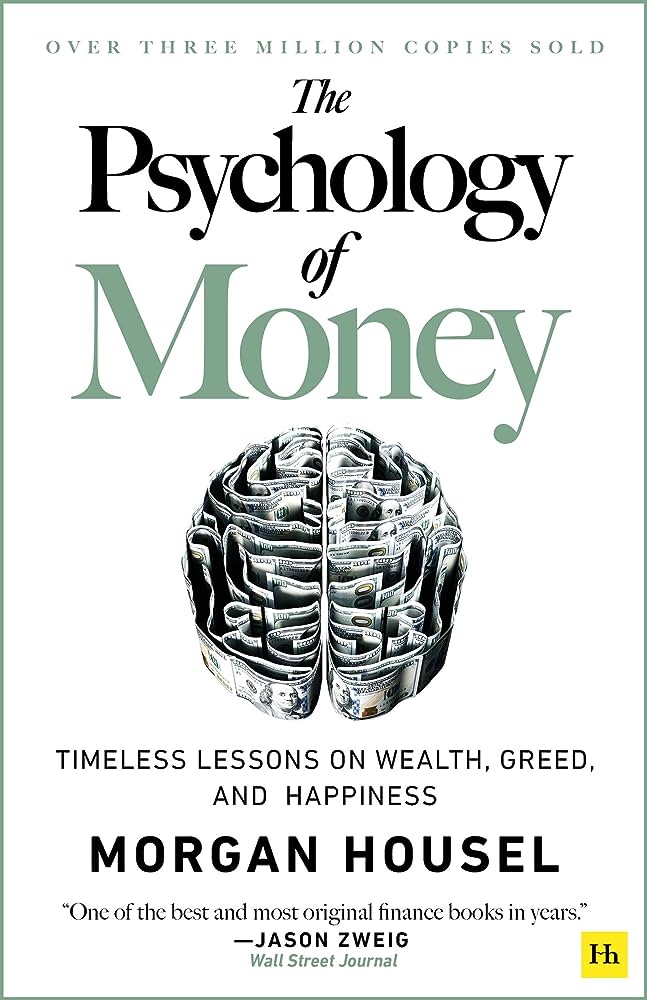

Julia's notes on The Psychology Of Money
The Psychology Of Money by Morgan. Housel and Morgan Housel
30 notes
first 25, in reading orderP.84 More than your salary. More than the size of your house. More than the prestige of your job. Control over doing what you want, when you want to, with the people you want to, is the broadest lifestyle variable that makes people happy.
P.56 Good investing is not necessarily about making good decisions. It’s about consistently not screwing up.
P.105 think about this in the context of professional investors…how much effort, time it costs to add a tenth of a percentage point to their returns…while you can save more with less effort by with adjusting your lifestyle.
P.107 you don’t need a specific reason to save. You can just save for saving’a sake.
P.109 intelligence is not a reliable advantage in a world that’s become as connected as our has. But flexibility is.
P.128 History can be a misleading guide to the future of economy and stock market because it doesn’t account for structural changes that are relevant for today. Example: venture capital barely existed 25 years ago (outdated data how startups are financed).
P.147 Long-term planning is harder than it seems because people's goals and desires change over time.
P.168 It is a notion that assets have one rational price in a world where investors have different goals and time horizons. Example:…
P.177 Real optimists don't believe that everything will be great. That's complacency. Optimism is a belief that the odds of a good outcome…
P.207 Go out of your way to find humility when things are going right and forgiveness/compassion when they go wrong. Because it's never as…
5 more notes from The Psychology Of Money
Julia kept 30 notes on this book, each one pinned to the page it came from.
Read the rest in the app

Keep what you read, not just what you finished.
Booksense times your sessions and pins every note to the page it came from, so a paragraph from page 174 is still yours a year later. Free on iOS.