autonomy in particular over four aspects of work: what people do, when they do it, how they do it, and whom they do it with. Engagement emerges when people have autonomy over 4Ts: their task, their time, their technique, and their team.
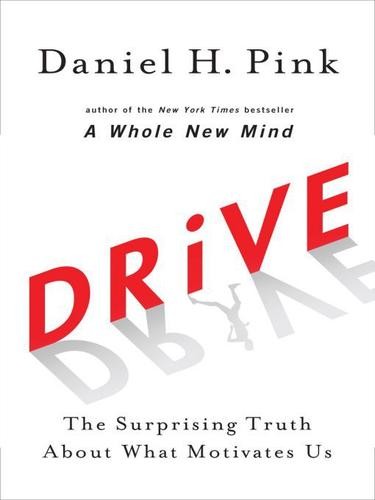
Drive
The Surprising Truth About What Motivates Us
About this book
From Daniel H. Pink, the author of the groundbreaking bestseller A Whole New Mind, comes his next big idea book: a paradigm-changing examination of what truly motivates us and how to harness that knowledge to find greater satisfaction in our lives and our work.We've been conditioned to think that the best way to motivate ourselves and others is through external rewards like money—the carrot-and-the-stick approach. That's a mistake, Daniel H. Pink says in his transformative new book. The key to high performance and satisfaction is intrinsic, internal motivation: the desire to follow your own interests and understand the benefits in them for you. And Pink has discovered thirty years of scientific data that confirm these ideas and show an exciting way forward.As he did in his groundbreaking bestseller A Whole New Mind, Pink lays out the hard science for these surprising insights, describes how people and corporations can embrace such ideas (some of them are already doing it), offers details about how we can master them, and provides concrete examples on how intrinsic motivation works on the job, at home, and in ourselves.This is a book of big ideas that explains how each of us can find the surest pathway to high performance, creativity, and even health and well-being.
Notes by reader
2 collectionsWhat readers marked
201 notes from readers tracking itResults-only work environment (ROWE): The brainchild of two American consultants, a ROWE is a workplace in which employees don't have schedules. They don't have to be in the office at a certain time or any time. They just have to get their work done.
"Now that" rewards: Rewards offered after a task has been com-pleted-as in "Now that you've done such a great job, let's acknow!-edge the achievement." "Now that" rewards, while tricky, are less perilous for nonroutine tasks than "if-then" rewards.
Nonroutine work: Creative, conceptual, right-brain work that can't be reduced to a set of rules. Today, if you're not doing this sort of work, you won't be doing what you're doing much longer.
Mastery asymptote: The knowledge that full mastery can never be realized, which is what makes its pursuit simultaneously alluring and frustrating.
"If-then" rewards: Rewards offered as contingencies as in, "If you do this, then you'll get that." For routine tasks, "if-then" rewards can sometimes be effective. For creative, conceptual tasks, they invariably do more harm than good.
Goldilocks tasks: The sweet spot where tasks are neither too easy nor too hard. Essential to reaching the state of "flow" and to achieving mastery.
Every note on this page was taken in Booksense.
Time your reading sessions, keep highlights on the page they belong to, and watch a streak build. Free on iOS.